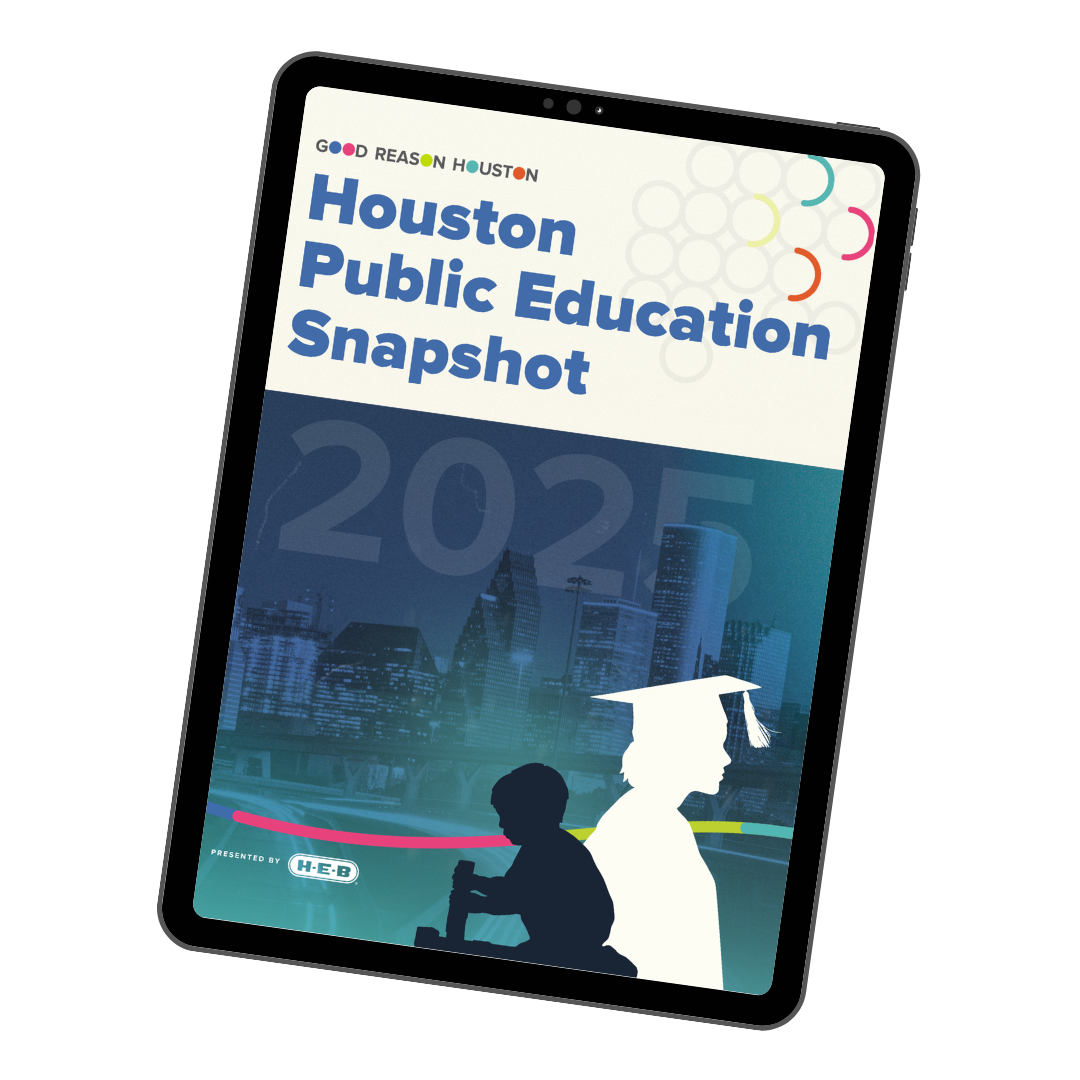
Good Reason Houston’s annual ConnectED convening unites more than a thousand Houstonians to rally behind a new regional North Star goal: to double the rate of public school graduates earning a living wage by 2040. Attendees from various sectors, including Pre-K-12 education, higher education, non-profit organizations, corporations, and philanthropy, all focused on a unified education continuum. This continuum follows student success from the first day of pre-K to the first day on the job, advancing an integrated, measurable cradle-to-career framework with clear milestones at every stage of a student’s journey. Encapsulated in our new Education Snapshot, the indicators track student progress across their educational and early career journey in three areas: Early Education, Core Development, and Postsecondary Success.
Our Education Snapshot ties the effectiveness of our pre-K-12, higher education, and workforce development systems to the ability of young people to pursue lives filled with choices and long-term economic opportunities. The young people reflected represent our region’s next generation of thinkers, creators, and leaders. Our region’s economic vitality depends on our ability to ensure they graduate from our public school system with the knowledge, skills, and experiences necessary for long-term success. Currently, only one in five of our high school graduates in the Houston region are projected to earn a livable wage as young adults, according to our original research. We know Houston can do better. And we’re committed to getting there. The Education Snapshot provides an overview of where we are in supporting our students on their path to prosperity, autonomy, and opportunity.
In this blog and the three that follow, we break down the indicators in more depth (for notes on our methodology, visit here.) The numbers help us see our strengths. With coordinated effort, we’ve begun to turn the tide on enrollment in early education experiences to reading and math achievement to college and career readiness. However, collective action is needed to ensure our students make the leap from high school to postsecondary opportunities. By embracing the indicators shared in the Education Snapshot, we can hold ourselves accountable as a community to building systems that support our students throughout their educational journeys and strengthen the entire Houston region.

From the First Day of Pre-K…
Pre-K is the first entry point into public school and sets a foundation for academic success later on. Generally, our students who need the most support ensuring they are ready for kindergarten qualify for free public pre-K programs. This includes children from economically disadvantaged backgrounds and those whose first language is not English.
Though the rate of public pre-K enrollment among eligible 3- and 4- year olds declined during the COVID-19 pandemic, the Houston region has made steady progress in returning to pre-pandemic enrollment levels. Still, less than half of eligible 3- and 4-year-olds were enrolled in public pre-K programs in 2024.
Kindergarten Readiness is an indicator of how well prepared students are when they enter the public school system. Do they have the foundational literacy and numeracy skills needed to start strong? We look at the percentage of assessed incoming kindergarteners who met early readiness standards in reading and math.
In 2024, nearly 60% of incoming kindergarteners were assessed as school-ready, up from 52% in 2023. Students who enrolled in public pre-K programs were even more likely to enter kindergarten school-ready.
Meeting grade level expectations in both reading and math early in elementary school enables students to build upon their knowledge and skills in later years. Research has long found that meeting grade level standards on math and reading by third grade is a key marker of students’ long-term academic success. Diverging from the traditional way of reporting student math and reading achievement separately, we look at the number and percentage of third graders that meet or master grade level standards in math and reading on STAAR together. Our region’s third graders were slightly less likely to meet standards in both math and reading in 2024 than in 2023, although this number will likely rise when the 2025 data becomes available given the widespread progress we saw on STAAR last school year.
To Core Development Years…
Continuing to measure the ability of our students to meet grade level standards in both reading and math throughout elementary and middle schools ensures that they maintain early momentum. The combined percentage of fourth through eighth graders meeting grade level standards on state-administered STAAR tests in both math and reading across our region made slight progress from 2023 to 2024. Again, we hope to see this number increase when the 2025 data becomes available from the state.
Thinking about student long term success, math is, unsurprisingly, critical. Good Reason Houston research has found that taking Algebra 1 in 8th grade is linked with higher likelihoods of attaining a postsecondary credential and earning a livable wage in young adulthood. The Houston region saw 31% of 8th graders take Algebra 1 in 2024, up from 29% in 2023. We expect this important marker to continue to grow as more and more districts build out their plans to fulfill their statutory obligations to expand access to advanced math pathways under Senate Bill 2124.
But the journey obviously doesn’t end when students take the test. Did students develop the advanced math and English skills needed to succeed when they graduate? STAAR EOC exams measure how well students accumulated the knowledge and skills we expect them to develop by the end of high school. More students across the Houston region met grade level standards on Algebra 1, English 1, or English II EOCs in 2024 than in 2023, and we hope to see this progress continue into 2025.
To the first day on the job
Where our gains for students in pre-K-12 grades shine bright spots on our investments in those subjects, our lack of gains in the postsecondary success part of the continuum highlight where we need to bolster our efforts.
High school graduation rates in the Houston region have consistently been near 90%. However, college enrollment for 2021 graduates within two years of high school dropped to below 50% due to the COVID-19 pandemic, though rates are slowly recovering. Postsecondary credential attainment within six years of high school has held steady at 27% for graduates between 2012-2017. Given the decline in college enrollment since 2017, this credential attainment rate is unlikely to rise without significant intervention. This is particularly important as graduates with postsecondary credentials are 3-5 times more likely to earn a livable wage. Our research released in January 2025 found only 20% of 2017 Houston-region graduates earned enough to qualify as a living wage in 2023, six years after high school
As we look to the future, we invite you to explore where we are today on our journey to our first major milestone: Increasing the number of students in the Houston region on the path to economic mobility by 45,000 by 2028. Join us in this work. Whether you’re an educator, business leader, policymaker, or concerned community member, you have a role to play in ensuring every Houston student has a path to economic mobility.